Showing posts with label previous works. Show all posts

Monday, January 3, 2011

Colours from Nature - natural dyeing, part III

A Day with Jjok ~ a.k.a Indigo

on the 31st of august 2003, my teacher took a couple of us to learn a korean technique for dyeing with indigo. at the time, i had no idea that it was indigo, i knew it as jjok. you may wonder why the colour seems to be green rather than the expected blue. green in the easiest colour to extract. the blue requires rigorous processing.

[while on a trip to Kyoto, Japan in february 2004, i learned of the Aizenkobo workshop, so i had to seek out their traditional method, & try my hand at indigo dyeing. i dyed a beautifully patterned scarf. it took about 3 hours to complete. the session included an introduction to the skill, packed with information on the craft, & was followed by a cup of tea with the family. The Utsuki family were really nice & answered our copious questions without hesitation. Their family have been dyeing with naturally fermented indigo for 3 generations, & are among only a few in the country who still dye this way. a few families produce the cloth patterns, one pattern to a family, so their sole work is to prepare cloth, basting a specific design for dyeing. alas, the scarf i produced is in Canada, no photos at this time. i did learn the process, though not having studied chemistry extensively, or the years working as an apprentice, i could not reproduce the colour on my own. perhaps in a future post, i could explain the day's events. for now, i've found another who's written about her experience with the workshop, Indigo Dyeing in Kyoto, & an article about the workshop, Beloved Blue.]


i apologize for the crappy images, they were taken with a cheap 35mm & scanned, & have been now copied from my old site, though i`ve tried to doctor them thru picasa.

Pickin' bagfuls
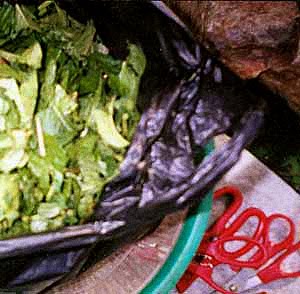

Snipped to bite-sized pieces


Soaking the jjok, reminiscent of a tisane

Tuesday, November 2, 2010

Colours from Nature - natural dyeing, part II


july 28~30th, 2001

this is another trip centered on natural dyeing. teacher conducted the weekend seminar in the town of 'Kong-gu', about an hour outside of Seoul. 'Kong-gu' is a nice town, full of artisans & beautiful people! there is a lovely museum in the village that exhibits many traditional items used throughout Korean history. i will have to contact my teacher to remember its name, then i will post it here.


it was a busy weekend as we dyed three colours; yellow (tumeric), purple (an insect casing, cochineal?) & a burnt orange (immature persimmon). as with the other posts on dyeing, these fun-filled days were a good couple of years ago, & very little English was spoken, so please bear with me as i pull my cerebral strings. i may have more detailed accounts which can be included someday, once i return to Canada, where my belongings & memories are in storage.

here's a peep at the day's events...


First Colour ~ Yellow (Turmeric)

Straining

for the dye bath, the bark was brought to boil & simmered for some time, until teacher deemed it ready. i can not recall if there was a mordant used, but the cloth turned out beautifully rich, so i'm guessing yes... with alum.


Drippin'

it was then strained onto a piece of muslin, which sits atop of a round flat basket for support, to drip.

Saturday, October 30, 2010

Colours from Nature - natural dyeing, part I

In March 2000, i began my studies with Yoo Hee-soon, an embroidery professor for Dong-guk Dae, a buddhist university in Seoul, South Korea. i can't say enough about her as she is one of the loveliest people i've ever met. she is always patient, & is willing to teach me anything i want to learn. she has taken me on a few expeditions to a temple on a mountain in An Seong (a town outside of the city) to teach me the art of dyeing with natural colours.


Many times that year, teacher had taken me along with a few other students to An Seong, a little village about an hour & a half outside of Seoul, to naturally colour silk & ramie. these photos were taken on one of those sojourns.

The mountain road

Usually, we take a bus to the bottom of the mountain & walk up to the temple, about 20 minutes. the climb is not too difficult, but it is envigorating.


The Buddhist temple

The stairs to the right are not as easy as they may seem. a full day running up & down is noticed tomorrow. they lead to the Buddha statue & a shrine behind him.

The pots you see in the front are
'kimchi' pots. Koreans marinate cabbage, or other vegetable, in these pots with red chilies, hot pepper paste et al for several days & these become side dishes to a main course of stew or rice dish.


from behind the Buddha

Taken in spring, the azaleas in full bloom, my teacher strolls past in her traditional Korean dress, the 'hanbok'.

Sunday, April 5, 2009

some other projects from S. Korea

this bag is technically the first thing i've ever quilted, though i didn't know that was what we were going to do that day. my teacher had set up a workshop that i had agreed to, & this is what the day produced. the language barrier has always been a small thing between teacher & i. not that we've spoke of the heavens or politics, but we seem to understand each other in a visual, colourful way.


this hat was created on another workshop day. on both the bag & the hat, the decorations & knot are also hand made. i have another hat pattern cut & ready to be sewn. another ufo, it's been waiting for me since this day.


i'd like to take a brief moment, & tell you how wonderful my teacher is. she has devoted her life to her art, & loves to teach anyone willing to learn anything they ask, including an awesome pumpkin porridge, i'll share with you the next time i make it.


i'd like to thank you teacher for being so kind & patient with your boundless energy, & for sharing your art, your life.

Sunday, March 29, 2009

pics of screen panels

these next close-up photos are the 4 panels of my folding screen. Shin, SaImDang (1504-1551) painted them during the Joseon dynasty. she became one of the most famous female artists in the 5,000 year-long Korean history. her work is known for the stylised subjects of insects, birds & other animals, plants & fruit which is referred to as chochungdo. She is also honoured & respected as her son, Yulgŏk, became a famous Confucian scholar. & she is considered to be the mother of modern Koreans. she lived with her parents at her family's Kangwon Province ancestral home, Ojukeon. her life consisted of caring for her husband & aging parents, raising seven children & artistic use of her education of Chinese classics, poetry, calligraphy & embroidery invested in by her father.

the photos are presented in the order i embroidered them. each colour used, is embroidered with 3 shades for a more natural feel. the thread is mostly hand-dyed silk with the stitches in long & short lengths. there are some french knots used for the eyes of the butterflies, strawberry seeds, & for other decorative embellishments.


i really enjoy this type of embroidery. especially in the quiet with the window ajar, listening to the breeze & the sound of silk on silk. left only with the form of the line & the beautifully coloured thread.


Tuesday, February 24, 2009

a beginning must...

i'd like to get this blog rolling, so i thought i'd post a pic or 2 on some previous projects. i don't have any pics of some of the things i'm working on now. perhaps for my next post. below is my very first try at traditional Korean embroidery, known as jasu. i was very lucky to meet my teacher, Yoo HeeSoon, the second month i had arrived in Seoul, & began studying this beautiful art of embroidering silk on silk.


this next piece consumed the next year i was there, but it was 4 separate panels. these paintings are by a woman of the 16th century named, Shin Sa Im Dang. these pictures are not traditionally embroidered. my teacher sketched them, & i transfered the drawings onto the silk.

this link will take you to her Cockscomb print which is one of the pieces i've embroidered in the screen.


i have close up shots of each panel, but, dag nammit, they're not accessible on this computer. perhaps another time.